
Careers · Šeškinė and Lentvaris
Student internship at an electronics repair shop
We take on electronics, mechatronics and IT students for their work placement. You will be in the shop next to a technician, working on customers’ devices rather than training rigs. The internship is unpaid; in return you get real repairs, the paperwork your school needs and, if things go well and a position happens to be open, an offer to stay.
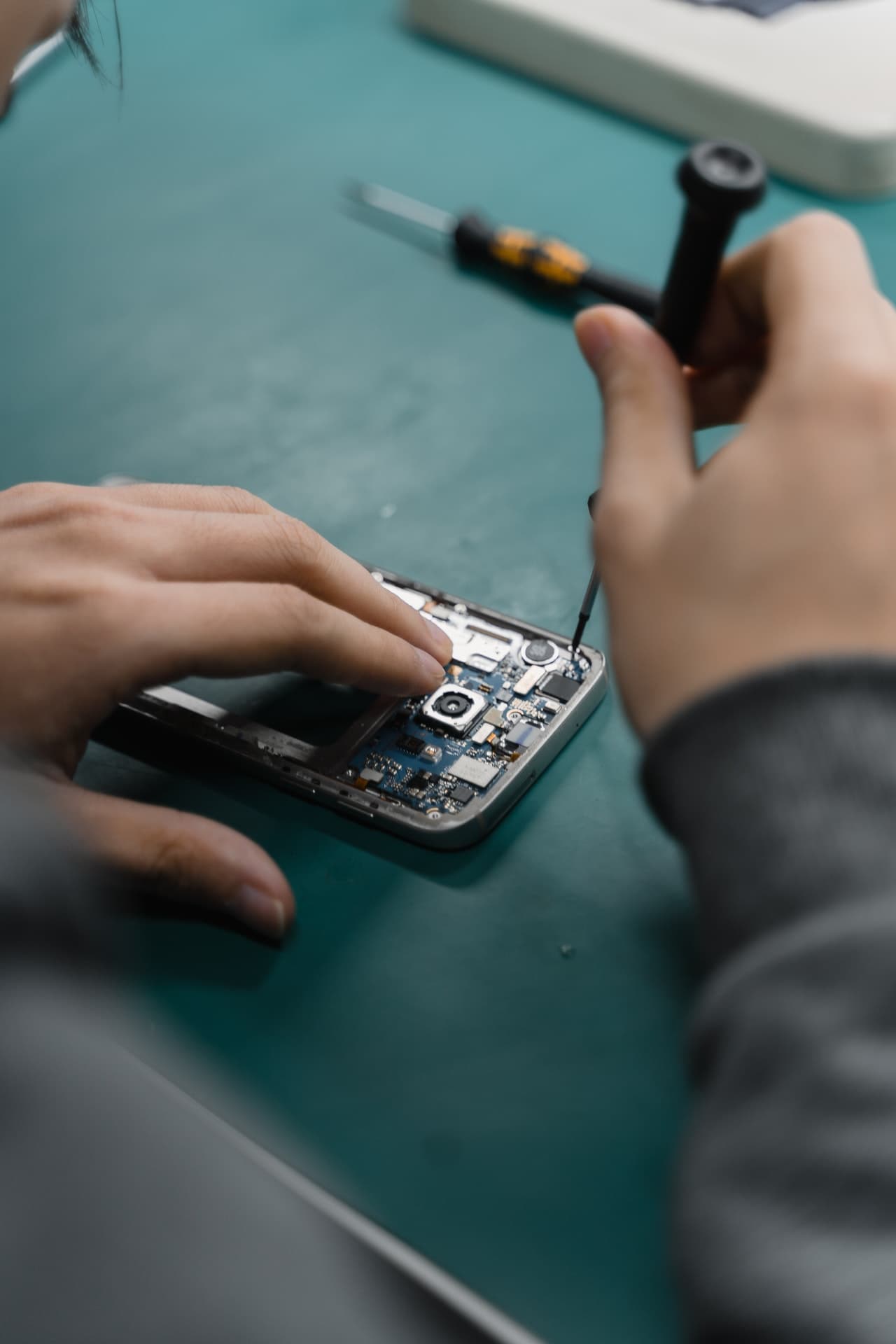
What you will actually be doing
The programme is adjusted to your field of study and to how much soldering you have already done. Below is the usual path an intern takes.
Diagnostics
Multimeter, thermal camera, manufacturers’ test software. You start with the clearer faults — charging port, battery, liquid damage — and go deeper as far as the placement allows.
Screen and battery replacement
iPhone, Samsung, Xiaomi and Huawei series. Opening a device without tearing the flex cables, adhesive work, resealing, and how an original part differs from a cheap replacement.
Boards and soldering
Micro-soldering basics and cleaning boards in an ultrasonic bath. BGA chip reballing you will watch rather than do — nobody gets a customer’s board to work on alone during a placement.
Laptops
Cleaning cooling systems and replacing thermal paste, swapping memory and drives, reinstalling the system, replacing panels.
Intake and customers
How to write an intake report, what has to be recorded before a device is opened, and how to explain a fault to someone with no technical background. That is a separate skill and lectures do not teach it.
How the internship starts
You write or drop in
In your email state your school, study programme, year and the period you need. Walking into a shop and asking works just as well.
A talk at the shop
About half an hour: what you expect, what you have taken apart before, what your timetable looks like. We show you the workbenches.
The agreement
We sign the three-party placement agreement on your school’s form. If your university has its own programme description, we work to it.
The first days
Safety briefing, tools, ESD rules. Your first independent jobs are the simpler repairs, with a technician watching and checking the result.
Paperwork and terms
Report for your school
We fill in the supervisor’s part and sign the report according to your programme’s requirements.
Certificate
At the end we issue a named EFIX certificate listing the work you carried out.
Length
We take placements from four weeks. From roughly two months an intern starts working more independently — a shorter stay stays mostly observation.
Schedule
Arranged around your lectures, but you need to be in the shop at least three days a week, otherwise the skill never builds up.
Mentor
One specific technician supervises you rather than the whole team in turn. You ask them, instead of looking for whoever is free.
Who this internship suits
It suits you if
- you study electronics, mechatronics, IT or a related field
- you like working with your hands on physical devices, not only with code
- you can get to the Šeškinė or Lentvaris shop at least three days a week
- you are fine with the first attempts going wrong and having to redo them
It does not if
- you are looking for a paid placement — this one is unpaid
- you only need a signature on a report without actually turning up
- you are interested purely in programming or network administration
- your period is shorter than a month
Where the internship takes place
EFIX Šeškinė
Musninkų g. 1
I–V 9:00–18:00
EFIX Lentvaris
Geležinkelio g. 34
I–V 10:00–18:00 · VI 10:00–14:00
Get in touch about the internship
Send an email with your school, study programme and the period you need, and we will arrange a talk.
info@efix.ltor call
+370 52 59 55 04